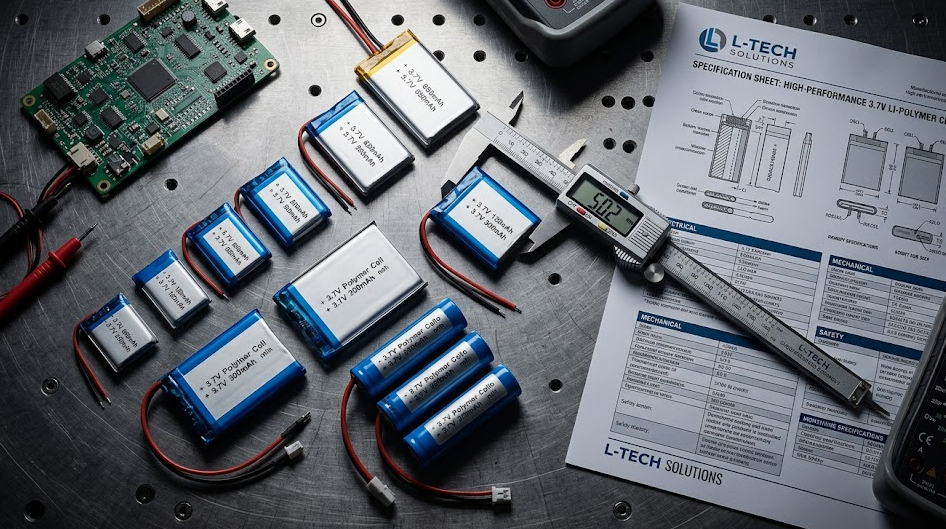
The 3.7V polymer battery has become a standard component across consumer electronics, industrial IoT, and medical device design. Its thin, flexible construction and high energy density make it a practical choice wherever rigid cylindrical cells don’t fit — physically or functionally. This article covers the technical profile, application sectors, and procurement criteria that matter most for engineering and sourcing teams.
Technical Profile of the 3.7V Polymer Battery
Lithium polymer (LiPo) cells use a gel or solid polymer electrolyte in place of the liquid electrolyte found in conventional lithium-ion cylinders. This allows manufacturers to seal the cell in a lightweight aluminum-plastic pouch rather than a rigid metal casing.
Core specifications:
- Nominal voltage: 3.7V
- Charge voltage: 4.2V (standard); 4.35V (high-voltage variants)
- Discharge cutoff: 3.0V
- Energy density: 200–265 Wh/kg, depending on cell construction
- Self-discharge rate: ~2–3% per month at room temperature
- Cycle life: 300–500 cycles at 80% capacity retention (standard grade); 500–1000+ cycles (high-cycle variants)
Engineers should note that polymer cells are more sensitive to overcharge and mechanical stress than cylindrical cells. Nearly all applications require a protection circuit module (PCM) or battery management system (BMS) to prevent overcharge, over-discharge, and short circuit conditions.
Form Factor Advantages of the 3.7V Polymer Battery
The pouch format delivers several structural advantages over cylindrical and prismatic alternatives:
- Thin profile — Cells are routinely manufactured below 5mm in thickness, enabling slim device designs that cylindrical cells cannot accommodate.
- Custom dimensions — Unlike standardized cylindrical sizes, polymer cells can be produced to customer-specified dimensions, including irregular and curved shapes.
- Weight efficiency — Pouch packaging contributes minimal dead weight compared to steel or aluminum casings, improving gravimetric energy density at the pack level.
- Stacking flexibility — Multiple cells stack easily into compact battery packs without wasted space between housings.
Application Sectors
Consumer Electronics Smartphones, tablets, laptops, and wireless audio devices represent the largest market for 3.7V polymer battery. The format’s thin profile and custom sizing enable the industrial design freedom that consumer product teams require.
Drones and Unmanned Vehicles High-discharge-rate LiPo packs power the motors in commercial and recreational drones. These applications require cells with high continuous and peak C ratings, low internal resistance, and consistent performance across charge cycles.
Wearables and Medical Devices Smartwatches, fitness trackers, and body-worn medical monitors rely on thin, lightweight polymer cells that conform to ergonomic housing constraints. For regulated medical applications, cells must meet relevant biocompatibility and safety certification requirements.
Industrial IoT and Asset Tracking Compact polymer cells power wireless sensor nodes, GPS trackers, and handheld scanners in industrial environments. Cycle life and operating temperature range are the primary selection criteria in these deployments.
Procurement and Safety Considerations
Protection Circuit Requirements: Specify whether the cell requires an integrated PCM or will connect to an external BMS. Designers should use unprotected cells only where the device’s own electronics handle all protection functions.
C Rating and Pulse Performance Confirm the cell’s continuous discharge rating and peak pulse rating match the application’s load profile. Undersized C ratings cause voltage sag and accelerated capacity degradation.
Certifications: For consumer products sold internationally, UN38.3 certification is required for transport. CE, UL, and KC marks are required in their respective markets. Medical applications carry additional certification obligations depending on device classification.
Dimensional Tolerances Polymer cells expand slightly during charge and age. Device housings should account for swelling tolerances — typically 0.1–0.3mm — to avoid mechanical stress on the pouch.
Procurement teams evaluating vendors should request cycle life test data, capacity retention curves, and safety certification documentation. Comparing specifications from qualified 3.7V polymer battery manufacturers gives sourcing teams a reliable baseline for supplier selection.
Specifying the Right Cell From the Start
The 3.7V polymer battery rewards careful specification. Matching capacity, C rating, dimensions, cycle life, and protection requirements to the actual application at the design stage avoids costly redesigns and field reliability issues. For teams working across multiple product categories, establishing a qualified supplier relationship early simplifies procurement across projects.