Choosing a makeup base used to be relatively simple: pick a foundation, blend it in, and move on. Today, there are skin tints, tinted moisturizers, foundations, concealers, serum bases, and plenty of products that seem to sit somewhere in between.
So what’s the actual difference between them?
The short answer is coverage, texture, finish, and purpose. A skin tint is generally designed to even out your complexion while keeping the skin looking natural. Foundation offers more coverage and can create a more polished base. Concealer is usually used more selectively to cover specific areas such as blemishes, dark circles, or redness.
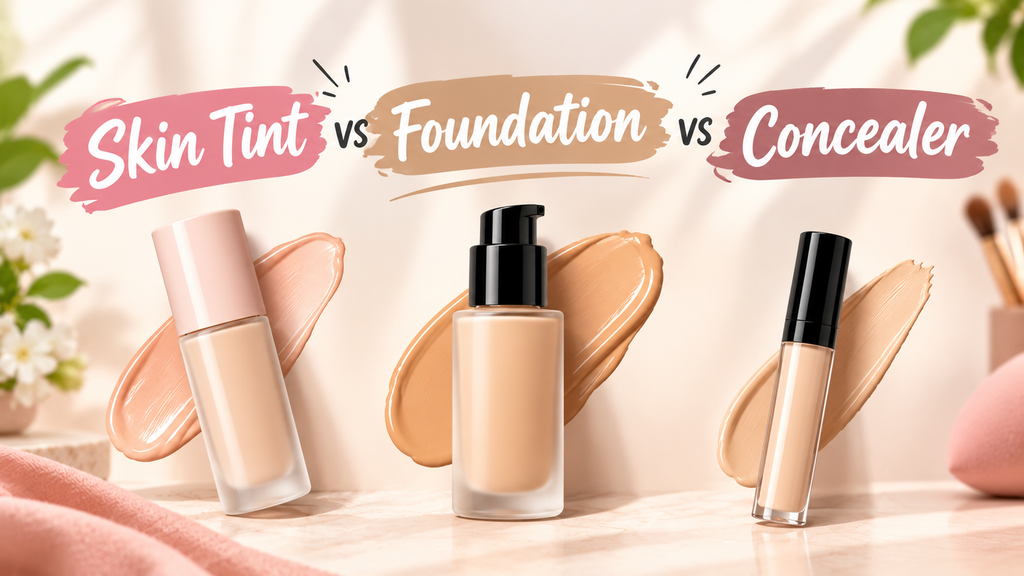
Here’s how to decide which one belongs in your makeup routine.
Skin Tint vs Foundation vs Concealer: The Basics
Before choosing between them, it helps to understand what each product is designed to do.
What Is a Skin Tint?
A skin tint is a lightweight complexion product designed to subtly even out your skin tone without creating a heavy makeup appearance.
Most skin tints provide sheer to light coverage, although some newer formulas can be built up to medium coverage. They often have a fluid or serum-like texture and may leave the skin with a natural or dewy finish.
They’re particularly useful when you want your complexion to look more even while still allowing freckles, natural texture, and some imperfections to show through.
Choose a skin tint when you want:
- Lightweight, comfortable coverage
- A natural-looking complexion
- A quick everyday makeup routine
- A fresh or slightly dewy finish
- Your natural skin to remain visible
What Is Foundation?
Foundation is designed to create a more even base and is available in a much wider range of coverage and finishes.
Depending on the formula, foundation can provide anything from sheer coverage to full coverage. You can also find liquid, powder, cream, stick, serum, and mousse foundations.
Foundation generally makes more sense when you want to noticeably even out your complexion or create a more polished base for the rest of your makeup.
Choose foundation when you want:
- Medium to full coverage
- Longer-lasting makeup
- More control over your finish
- Better coverage of discoloration or redness
- A more polished makeup look
What Is Concealer?
Concealer is usually more concentrated than foundation and is designed to target specific areas.
You might use it under the eyes, around the nose, over blemishes, or anywhere you need a little extra coverage.
Unlike foundation, you don’t necessarily need to apply concealer across your entire face.
Choose concealer when you want to:
- Cover individual blemishes
- Reduce the appearance of dark circles
- Add extra coverage to areas that need it
- Brighten certain parts of the face
- Correct small areas of discoloration
The Key Differences at a Glance
| Feature | Skin Tint | Foundation | Concealer |
| Coverage | Sheer–Light | Light–Full | Medium–Full |
| Texture | Usually lightweight | Varies by formula | Usually thicker |
| Main purpose | Even skin tone | Create an overall base | Target specific areas |
| Finish | Natural/Dewy | Matte, Satin, Natural or Dewy | Depends on formula |
| Application | Fingers, sponge or brush | Sponge, brush or fingers | Brush, sponge or fingers |
| Best for | Everyday makeup | Versatile makeup looks | Spot coverage |
These are general guidelines rather than strict rules. Modern makeup formulas can blur the lines between categories.
Which One Is Right for Your Skin Type?
Your skin type can help narrow down your options, but it shouldn’t be the only deciding factor.
Oily Skin
If your skin becomes shiny throughout the day, look for lightweight formulas with a natural or semi-matte finish.
A foundation may provide better staying power when you need more coverage, while a skin tint can work well for casual makeup if you prefer a lighter feel.
You can use the Concealer only where additional coverage is necessary.
Dry Skin
Dry skin often looks better with hydrating formulas and natural or dewy finishes.
A lightweight skin tint can work particularly well for everyday makeup because it doesn’t necessarily emphasize dry texture as much as some heavier formulas.
If you need more coverage, look for a hydrating foundation and make sure your skin is properly moisturized beforehand.
Combination Skin
Combination skin may benefit from using different products or finishes in different areas.
For example, you could use a lightweight base across your face and apply a little powder or concealer only where needed.
A satin or natural finish can also provide a useful middle ground between overly matte and overly dewy makeup.
Normal Skin
If your skin is relatively balanced, you have the most flexibility.
Your choice can simply come down to the amount of coverage and finish you prefer.
Skin Tint or Foundation: Which Is Better for Everyday Makeup?
Neither is automatically better.
If you’re going to work, running errands, meeting friends, or simply want your skin to look a little more even, a skin tint can be a convenient choice.
It’s lightweight, quick to apply, and doesn’t require you to create a full makeup look.
Foundation makes more sense when you want stronger coverage or a more finished appearance.
For many people, the answer isn’t choosing one product forever. You can keep both and use them depending on the occasion.
When Should You Use Concealer?
Concealer is particularly useful when your overall complexion looks good but a few areas need extra attention.
For example, you might use a skin tint across your face and then apply concealer to:
- Dark circles
- Individual blemishes
- Redness around the nose
- Acne marks
- Areas of uneven pigmentation
This approach can actually create a more natural-looking result than applying a high-coverage foundation everywhere.
Can You Use Skin Tint and Foundation Together?
Yes, but you don’t always need to.
One approach is to apply a thin layer of skin tint across the face and then use foundation only in areas where you want more coverage.
Another option is to use foundation as your main base and apply a lighter complexion product to refresh areas later.
However, layering two complexion products across your entire face can become unnecessarily heavy. Start with one product and add another only where you actually need it.
Can You Use Concealer Instead of Foundation?
You can, particularly if your skin doesn’t need much overall coverage.
Apply a small amount of concealer to areas such as blemishes, redness, or under the eyes, then blend it carefully.
This technique can create a very natural result because you’re covering only the areas that need additional coverage rather than covering your entire complexion.
It’s especially useful for quick makeup days when you don’t want to wear a full base.
How to Apply Skin Tint
Skin tint is generally forgiving, which makes it convenient for everyday makeup.
Start with clean, moisturized skin. Apply a small amount to the center of your face and blend outward using your fingers, a damp sponge, or a brush.
Because the coverage is usually light, don’t worry about making every imperfection disappear.
The goal is to create a more even-looking complexion while keeping the skin looking like skin.
How to Apply Foundation
Foundation usually requires a little more attention to application.
Start with a small amount and spread it from the center of your face outward. Build additional coverage gradually instead of applying a thick layer immediately.
Pay particular attention to the jawline, hairline, and around the nose.
If you need more coverage in a specific area, adding a little concealer may be better than adding another layer of foundation everywhere.
How to Apply Concealer
The amount of concealer you need is usually much smaller than you think.
For blemishes, use a small amount directly over the area and blend the edges without completely removing the product from the center.
For under-eye concealing, use a thin layer and focus on the areas where darkness is most visible.
If you’re using concealer to brighten, choose a shade that is only slightly lighter than your natural complexion rather than going dramatically lighter.
What About Finish and Coverage?
Coverage and finish are two different things.
A foundation can be full coverage and dewy, or full coverage and matte. Similarly, a skin tint can be sheer and dewy or sheer with a more natural finish.
Think of them as two separate questions:
How much do I want to cover?
That’s your coverage.
How do I want my skin to look afterward?
That’s your finish.
Understanding this distinction makes shopping for complexion products much easier.
Don’t Forget Your Undertone
Whatever complexion product you choose, shade matching still matters.
Your skin tone describes the depth of your complexion, while your undertone refers to the subtle color underneath it.
Common undertones include:
- Warm
- Cool
- Neutral
- Olive
When testing a foundation or skin tint with several shades, compare them along the jawline rather than relying only on your hand.
If you’re shopping online, look at the brand’s shade descriptions and swatches, and pay attention to reviews from people with similar skin tones and undertones.
How Long Do Skin Tints and Foundations Last?
Wear time depends heavily on the formula, your skin type, your skincare underneath, weather conditions, and how much product you apply.
In hot or humid conditions, lightweight products may still require some touch-ups, particularly if your skin becomes oily.
If longevity is your priority, look for formulas specifically designed for long wear and consider setting areas that tend to become shiny.
You don’t necessarily need to set your entire face with powder.
Frequently Asked Questions
Is a Skin Tint the Same as Foundation?
No. Both cover the whole face, but a skin tint offers lighter coverage with a skincare-forward, natural finish, while foundation offers more buildable coverage for correcting tone and texture.
Can Concealer Replace Foundation?
Not effectively for full-face coverage. Concealer is thicker and made for small areas. Using it across the entire face can look heavy and cakey. It’s designed to complement a base, not replace one.
Which Lasts Longer, Foundation or Skin Tint?
Foundation generally has more staying power due to higher pigment and film-forming ingredients. Skin tints, being lighter, often need a touch-up or setting powder for longer wear.
Do Skin Tints Have SPF?
Many do, but not all. Always check the product label. If sun protection is a priority, look for a skin tint or foundation with a stated SPF rather than assuming it provides adequate protection.
What Goes on First, Concealer or Foundation?
Foundation or skin tint typically goes first to establish an even base, with concealer applied afterward only where extra coverage is needed.
Which One Should You Choose?
There’s no universal winner between skin tint, foundation, and concealer because they solve different makeup problems.
Choose a skin tint when you want lightweight, natural-looking coverage.
Choose foundation when you want a more even and polished complexion with greater control over coverage and finish.
Choose concealer when you only need additional coverage in specific areas.
And don’t be afraid to combine them. A skin tint with targeted concealer can create a very natural everyday look, while foundation and concealer can provide more coverage when you’re getting ready for an event.
The best complexion routine is the one that gives you the amount of coverage you actually want without making your skin feel buried under makeup.