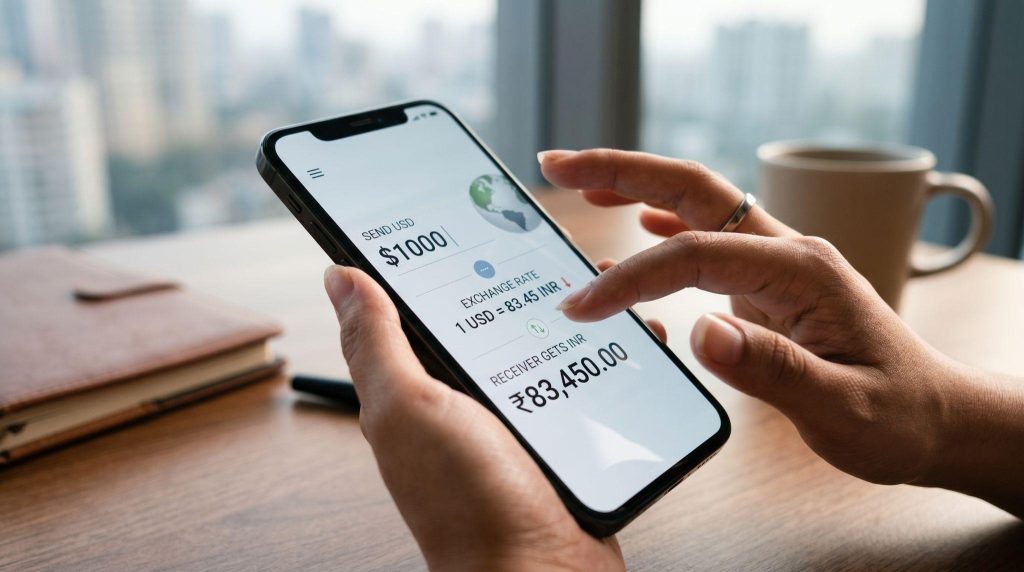
In an increasingly globalised world, sending money across borders has become a routine necessity. Whether you are supporting family overseas, paying international tuition fees, or managing business transactions, understanding currency exchange rates is essential. These rates directly determine how much money your recipient ultimately receives. Even small fluctuations can significantly affect the value of an international money transfer, making it crucial to grasp how exchange rates work and how they influence costs.
What are currency exchange rates?
Currency exchange rates represent the value of one currency in relation to another. For example, if 1 US Dollar equals ₹94, it means one dollar can be exchanged for 94 Indian Rupees.
Exchange rates are not fixed; they fluctuate constantly due to global economic conditions, market demand, geopolitical stability, and central bank policies. These fluctuations are the primary reason why the amount received in an international transfer may differ from expectations.
Why exchange rates matter in international money transfers
When you send money abroad, your funds are converted from one currency to another. The exchange rate applied at that moment determines the final amount received.
Here’s why this matters:
- A favourable rate means the recipient gets more money
- An unfavourable rate reduces the transferred value
- Even a small difference in rates can result in noticeable losses on large transfers
For instance, a variation of just ₹1 in the exchange rate can lead to a difference of ₹1,000 on a $1,000 transfer.
Key factors that influence exchange rates
Here are some key factors that impact exchange rates:
1. Supply and demand
Currencies behave like commodities. If demand for a currency increases, its value rises. Conversely, lower demand weakens it.
2. Inflation rates
Countries with lower inflation typically see stronger currencies. Higher inflation often leads to depreciation.
3. Interest rates
Higher interest rates attract foreign investors, increasing demand for that currency and strengthening its value.
4. Political and economic stability
Stable economies tend to have stronger currencies, while uncertainty or crises can weaken exchange rates.
5. Market speculation
Traders and investors often speculate on currency movements, which can cause short-term fluctuations.
Hidden Costs Beyond Exchange Rates
While exchange rates are critical, they are not the only factor affecting international transfers. Many providers include hidden charges that impact the final amount.
1. Forex markup
Financial institutions often add a markup over the real exchange rate. This can range up to 5%, increasing the cost of the transfer.
2. Transfer fees
Flat fees or percentage-based charges may apply depending on the provider.
3. Intermediary bank charges
In some cases, intermediary banks deduct fees during the transfer process.
These costs, combined with exchange rate differences, can significantly reduce the value received by the beneficiary.
Real vs Marked-Up Exchange Rates
The mid-market rate (also known as the interbank rate) is the real exchange rate used by banks when trading currencies among themselves. However, customers rarely get this rate.
Instead, most providers offer a marked-up rate, which includes their profit margin. For example:
- Mid-market rate: ₹94 per USD
- Offered rate: ₹92 per USD
This ₹2 difference may seem small but can lead to substantial losses on larger transfers.
Role of technology in exchange rates
Modern financial technology has improved transparency in international transfers. Many platforms now display real-time exchange rates, allowing users to make informed decisions.
Additionally, digital banking solutions enable faster transfers, better tracking, and reduced hidden charges, making international money transfers more efficient and cost-effective.
Niyo currency exchange: A smarter way to manage forex
When it comes to managing currency exchange rates for travel or international payments, choosing the right platform can make a significant difference. One option designed specifically for this use case is Niyo currency exchange, which focuses on transparency, cost savings, and convenience.
Why it stands out
Zero forex markup
Niyo offers foreign currency at zero forex markup on live exchange rates, meaning there is no additional percentage added on top of the base rate. This helps you stay closer to the real (mid-market) rate and avoid hidden conversion costs.
Better rates than traditional options
Compared to airport counters and local vendors, Niyo’s rates can be significantly more competitive, helping travellers save on overall forex costs.
Doorstep delivery of foreign currency
You can order foreign cash online and get it delivered to your doorstep, often within a day in major cities. This eliminates the need to visit exchange counters physically.
Wide currency coverage
Niyo supports a broad range of global currencies, making it suitable for travellers visiting multiple countries.
Buyback guarantee
Unused foreign currency can be sold back at live rates, reducing losses from leftover cash after your trip.
How does it help with exchange rate impact?
Niyo directly addresses two major challenges in international money transfer and forex usage:
- Eliminates hidden markups, ensuring you don’t lose value during conversion
- Uses live exchange rates, reducing the gap between what you see and what you get
- Improves transparency, so you can plan your expenses more accurately
Common mistakes to avoid
Here are some mistakes that you should avoid:
- Ignoring exchange rate fluctuations
- Not checking the mid-market rate
- Overlooking hidden fees and markups
- Transferring large amounts without comparing providers
- Assuming all platforms offer similar rates
Avoiding these mistakes can help you retain more value during international transactions.
In a nutshell
Understanding how currency exchange rates impact international money transfers is essential for anyone sending money abroad. Exchange rates directly influence the amount received, and even small variations can lead to significant differences.
By staying informed, comparing providers, and choosing cost-effective solutions, you can minimise losses and ensure that your money goes further. In a world where global transactions are increasingly common, being aware of exchange rate dynamics is not just helpful; it is necessary for smarter financial decisions.