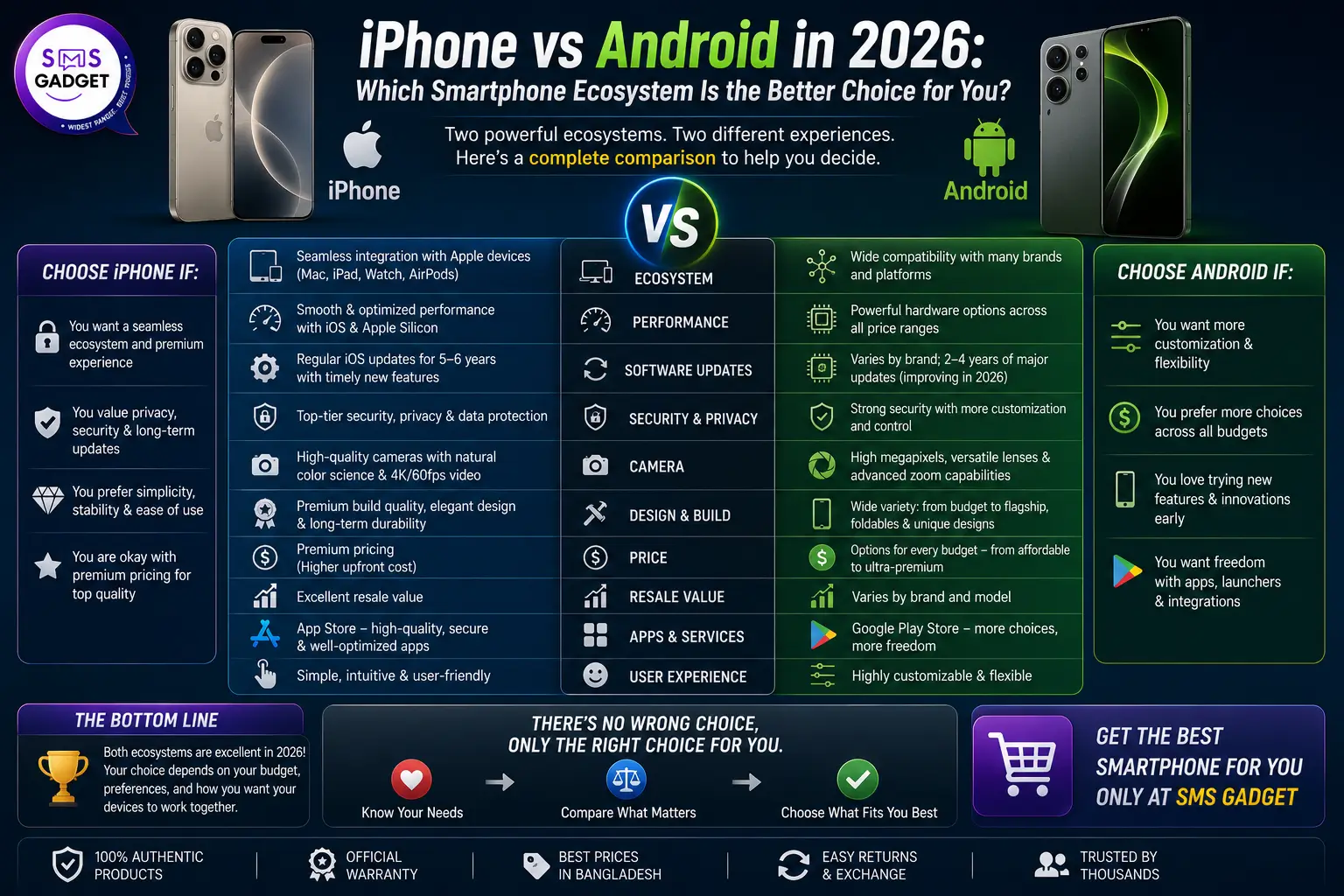
Still can’t decide between an iPhone and an Android? In 2026, both platforms have evolved so much that choosing between them is harder than ever. Here’s the core difference in one line: iPhone means a polished ecosystem, strong security, and long-term support. Android means budget variety, deep customization, and hardware freedom.
In this article, we compare everything, performance, camera, battery, AI, security, and price, including a Bangladesh-specific buying guide. Here’s the full comparison.
iPhone is best for ecosystem users, content creators, and privacy-conscious buyers. Android is best for budget shoppers, customizers, and fast-charging lovers.
iPhone vs Android 2026 — At a Glance (Quick Summary Table)
| Feature | iPhone (iOS) | Android |
| Performance | A18 Bionic chip — industry best | Snapdragon 8 Elite Gen 5 — very close |
| Camera | Best-in-class video, natural colors | Higher megapixels, better zoom variety |
| Battery Life | Smaller battery, all-day efficient | 5,000–7,600 mAh, longer raw capacity |
| Charging Speed | Up to 30W (slower) | 80W–120W (much faster) |
| Customization | Limited but polished | Full control, widgets, launchers |
| Software Updates | 6–7 years guaranteed | Varies (2–7 years by brand) |
| AI Features | Apple Intelligence (privacy-first) | Google Gemini (feature-rich) |
| Security & Privacy | Strongest on mobile | Improved, but iOS still leads |
| Price (Bangladesh) | Tk 95,000 – Tk 2,17,000 | Tk 12,000 – Tk 1,60,000+ |
| Best For | Ecosystem users, creators, simplicity | Budget to flagship, customizers |
Performance — Which One Is Faster and Smoother?
iPhone leads in single-core speed and long-term consistency; Android excels in multi-tasking and gaming variety.
iPhone Performance
Apple designs its own chips—the A18 Bionic is built so that hardware and software are optimized together. As a result, apps open faster and the phone stays smooth even after three or four years. iPhone still leads the industry in single-core performance. iOS animations and scrolling are the smoothest on any mobile platform — something you feel in everyday use.
Android Performance
The Snapdragon 8 Elite Gen 5 now rivals the A18 Bionic in multi-core tasks and gaming. Android’s biggest advantage here is variety—powerful options exist at every price point, from budget to flagship. Split-screen multi-tasking and heavy workloads run well on Android. However, low-end Android phones may lose performance after a couple of years.
Performance Verdict
iPhone wins: long-term consistency and single-core speed.
Android wins: multi-tasking, hardware variety, and gaming performance.
Camera — Does iPhone or Android Take Better Photos?
iPhone leads in video; Android leads in zoom variety and megapixel count.
iPhone Camera — Why Content Creators Prefer It?
iPhone’s color science is natural and accurate—photos look professional even without editing. Video recording remains the industry standard: Cinematic Mode, ProRes support, stable 4K footage. Consistent output is available across all iPhone models, which is a major advantage for creators. Both Portrait Mode and Night Mode have improved further in 2026.
Android Camera — Why Photography Enthusiasts Choose It?
The Samsung S25 Ultra and Pixel 9 pack sensors up to 200MP. The optical zoom variety is far greater—options range from 10x to 30x. AI-based real-time scene detection has been a strength of Android cameras for years. Several Android models outperform iPhone in low-light and macro photography.
Camera Verdict
iPhone wins: video recording and consistent photo quality.
Android wins: hardware zoom variety and megapixel count.
Battery Life and Charging Speed — Which Has the Real Advantage?
iPhone battery lasts longer over time; Android charges much faster.
iPhone Battery — Smaller Capacity, But All-Day Life
The iPhone 17 Pro Max delivers up to 29 hours of video playback. Apple’s A-series chip is so efficient that a smaller battery still powers a full day — proven in real-world use. Battery health holds up well over the long term. Charging tops out at 30W, which is comparatively slow.
Android Battery — Bigger Capacity, Faster Charging
Android phones offer batteries ranging from 5,000 mAh to 7,600 mAh. With 80W–120W fast charging, a full charge takes less than 45 minutes. Many models support reverse wireless charging. Some low-end devices carry large batteries but have poor optimization, so real-world life varies.
Battery Verdict
iPhone wins: battery longevity and long-term health.
Android wins: raw battery size and charging speed.
AI Features — Apple Intelligence vs Google Gemini (2026)
iPhone’s AI is privacy-first; Android’s AI is feature-rich and more open to third parties.
Apple Intelligence — Privacy-First AI
Apple Intelligence is available on iPhone 15 Pro and the full iPhone 16 series. On-device AI processing means your data never leaves your phone. Siri’s contextual understanding has improved significantly in 2026. The Photos Clean Up feature removes backgrounds automatically. Writing tools, summarization, and smart replies are now more accurate than ever.
Google Gemini on Android — Feature-Rich AI
Gemini Nano provides on-device, low-latency AI processing. Offline image description in TalkBack improves accessibility without a network connection. Google Assistant integration is deeper than before. Third-party AI apps have far more flexibility on Android — a major draw for power users.
AI Verdict
iPhone wins: privacy-focused, secure on-device processing.
Android wins: breadth of AI features and third-party integration.
Security and Privacy — Which Platform Is Safer?
iPhone is the clear winner in security.
Why is iPhone Security So Strong?
Apple controls its entire ecosystem—from hardware to software, with no gaps between them. The App Store’s strict approval process means far less malware. Face ID, end-to-end encryption, and App Privacy Labels form a solid security layer. Ad tracking requires explicit user consent — no one can track you without opting in.
Android Security in 2026 — How Much Has It Improved?
Android 16 places a much stronger focus on privacy and security. From 2026, certified Android devices will only run apps from verified developers. Google Play Protect scans for malware in real time. However, the open ecosystem still carries comparatively higher risk by design.
Security Verdict
iPhone is the clear winner. If privacy is your top concern, iOS is the right choice.
Software Updates and Long-Term Support
iPhone delivers consistent updates across all models; Android varies widely by brand.
How Long Will an iPhone Receive Updates?
Apple typically supports iPhones for 6–7 years with iOS updates. Buying an iPhone 16 today means guaranteed updates through 2031–2032. Every supported iPhone receives updates at the same time — no delays.
How Consistent Are Android Updates?
Google Pixel and Samsung Galaxy S series now offer up to 7 years of updates. Mid-range Android phones get 3–4 years. Budget Android devices typically receive only 2–3 years of support. Brand-to-brand variation is significant — always check before buying.
Update Verdict
iPhone wins: consistent, guaranteed updates across all models.
Android wins: Pixel and Samsung flagship phones now match iPhone’s support timeline.
Customization and User Experience
Android is the clear winner in customization; iPhone leads in simplicity.
iPhone — Simple, Polished, and “Just Works”
iOS is clean and accessible to everyone. Home screen customization has expanded in 2026, though it still falls short of Android’s freedom. Developers typically launch their best apps on iOS first, keeping app quality high. Integration with Mac, iPad, Apple Watch, and AirPods is seamless.
Android — Freedom and Flexibility
Custom launchers, widgets, and default apps — everything can be changed to suit your preferences. Foldables, gaming phones, and stylus devices offer far more hardware variety. File management is more capable on Android. For power users, automation tools like Tasker go far beyond what iOS allows.
Customization Verdict
Android is the clear winner. No other platform comes close in flexibility and personalization.
Ecosystem — Apple Ecosystem vs Android/Google Ecosystem
Already in Apple’s world? Stick with iPhone. Want cross-platform flexibility? Go Android.
The Benefits of the Apple Ecosystem
iPhone, Mac, iPad, Apple Watch, and AirPods all work together seamlessly. iMessage, FaceTime, AirDrop, and Handoff make cross-device workflows smooth and natural. iCloud sync keeps data updated across all your devices automatically. For anyone already in the Apple ecosystem, iPhone is almost indispensable.
The Android/Google Ecosystem
Google Drive, Gmail, and Google Photos work on every platform — including iPhone. Switching away from Android doesn’t mean losing your Google ecosystem. Chromecast, Google Nest, and Samsung SmartThings give Android users more smart home flexibility. You also have the freedom to switch between brands at any time.
Ecosystem Verdict
iPhone wins: if you’re already invested in Apple’s ecosystem.
Android wins: if you want cross-platform flexibility and the freedom to switch.
Price Comparison — How Much Do iPhone and Android Cost in Bangladesh?
Android wins on budget variety; iPhone wins on resale value.
iPhone Prices in Bangladesh (2026)
| Model | Price (BDT) |
| iPhone 16e | Tk 95,000 |
| iPhone 16 | Tk 1,10,000+ |
| iPhone 16 Pro | Tk 1,65,000+ |
| iPhone 17 Pro Max | Tk 2,17,000+ |
Buying from an official channel ensures BTRC registration — no risk of network blocking. Grey market iPhones are cheaper but carry a real risk of BTRC IMEI block. EMI options are available at authorized resellers. For the best prices and more details, visit: Buy iPhone in Bangladesh.
Android Prices in Bangladesh (2026)
| Budget | Recommended Phones |
| Tk 12,000–20,000 | Redmi 13C, Realme C65 |
| Tk 20,000–35,000 | Redmi Note 14, Samsung Galaxy A35 |
| Tk 35,000–60,000 | Samsung Galaxy A55, OnePlus Nord CE 4 |
| Tk 60,000–1,00,000 | Samsung Galaxy S23, Google Pixel 8a |
| Tk 1,00,000+ | Samsung Galaxy S25 Ultra |
Android starts at just Tk 12,000 — there’s an option for every budget. Buying with an official warranty ensures proper after-sales service.
Price Verdict
Android wins: budget, variety, and value for money.
iPhone wins: resale value and long-term cost efficiency.
Resale Value — Which Phone Sells for More?
iPhone holds its resale value significantly better than most Android phones. A three-year-old iPhone still sells for a strong price, this holds in Bangladesh’s second-hand market as well. Samsung Galaxy S series and Google Pixel also retain value reasonably well. Budget Android phones, on the other hand, depreciate quickly.
Verdict: When the total cost of ownership is considered, iPhone has a clear long-term advantage.
iPhone vs Android — Which One Is Right for You?
Buy an iPhone If —
- You already use a Mac, iPad, or Apple Watch
- You create video content, or want simplicity in photography
- You want long-term software support (6–7 years)
- Privacy and security are your top priorities
- You want one premium phone and don’t plan to switch often
- You prefer a clean, polished experience that just works
Buy an Android If —
- Your budget is limited—you want a solid phone between Tk 15,000–50,000
- You love customizing your phone
- Fast charging and large battery capacity matter to you
- You want a foldable or stylus device
- You rely heavily on Google services
- You like trying different brands and form factors
Switching Between iPhone and Android — How Easy Is It?
Switching in 2026 is much easier than it used to be. Contacts, photos, and most app data can be transferred without much hassle. That said, leaving iPhone means losing access to iMessage and FaceTime. If you own an Apple Watch, switching becomes more complicated. Some paid apps may need to be repurchased on the new platform. This is a big decision, factor in how deeply invested you are in your current ecosystem before making the move.
Where to Buy — Where Should You Buy in Bangladesh?
Always buy from an official authorized reseller — it guarantees warranty coverage and BTRC registration. Avoid the grey market — IMEI blocking and voided warranties are real risks. Before buying online, verify the IMEI on the BTRC website. Trusted online shops also offer EMI options for easier payment. You can shop with confidence from the Best online mobile shop in Bangladesh.
Most Asked Questions About iPhone vs Android
Which is better in 2026 — iPhone or Android?
There is no universal winner in 2026. iPhone is the better choice if you prioritize security, ecosystem integration, and long-term software support. Android is better if customization, budget variety, and fast charging are your priorities. The right answer depends entirely on your lifestyle and budget.
Is buying an iPhone in Bangladesh a good idea?
Yes, if you have the budget and plan to use it long-term. Buy from an official channel — a BTRC-registered iPhone will work without any network issues. Grey market iPhones may be cheaper but carry a real risk of IMEI blocking and no warranty coverage.
Is Android as fast as iPhone?
In 2026, top Android phones running the Snapdragon 8 Elite Gen 5 come very close to the iPhone’s A18 Bionic. However, iPhone still leads in long-term performance consistency. Budget Android phones are more likely to slow down noticeably after a couple of years.
Is the iPhone camera better than Android?
For video quality, iPhone still leads. For still photography, top Android phones like the Samsung S25 Ultra and Google Pixel 9 are on par with — and in some areas ahead of — iPhone. Android offers much more variety in optical zoom range.
How long can you use an iPhone?
Apple typically provides 6–7 years of iOS updates. Buying an iPhone 16 today means you can expect updates through 2031–2032. From a long-term investment standpoint, iPhone offers excellent value.
Does Android charge faster than iPhone?
Yes. Android flagships support 80W–120W charging, reaching a full charge in under 45 minutes. iPhone tops out at 30W, which is considerably slower. If fast charging is important to you, Android is the clear choice.
Conclusion
iPhone means ecosystem + security + longevity.
Android means value + flexibility + variety.
In 2026, there is no universal winner, everything depends on your priorities. If you’re deeply invested in Apple’s ecosystem, the iPhone is the right call. If you need a great phone on a budget or want full control over your device, Android has you covered.
Match your decision to your budget and your needs. Buy from an official store and make sure your warranty is in order. smsgadget.com carries the latest models from both platforms at competitive prices, making it a reliable place to start your search.